by Julie Dodd
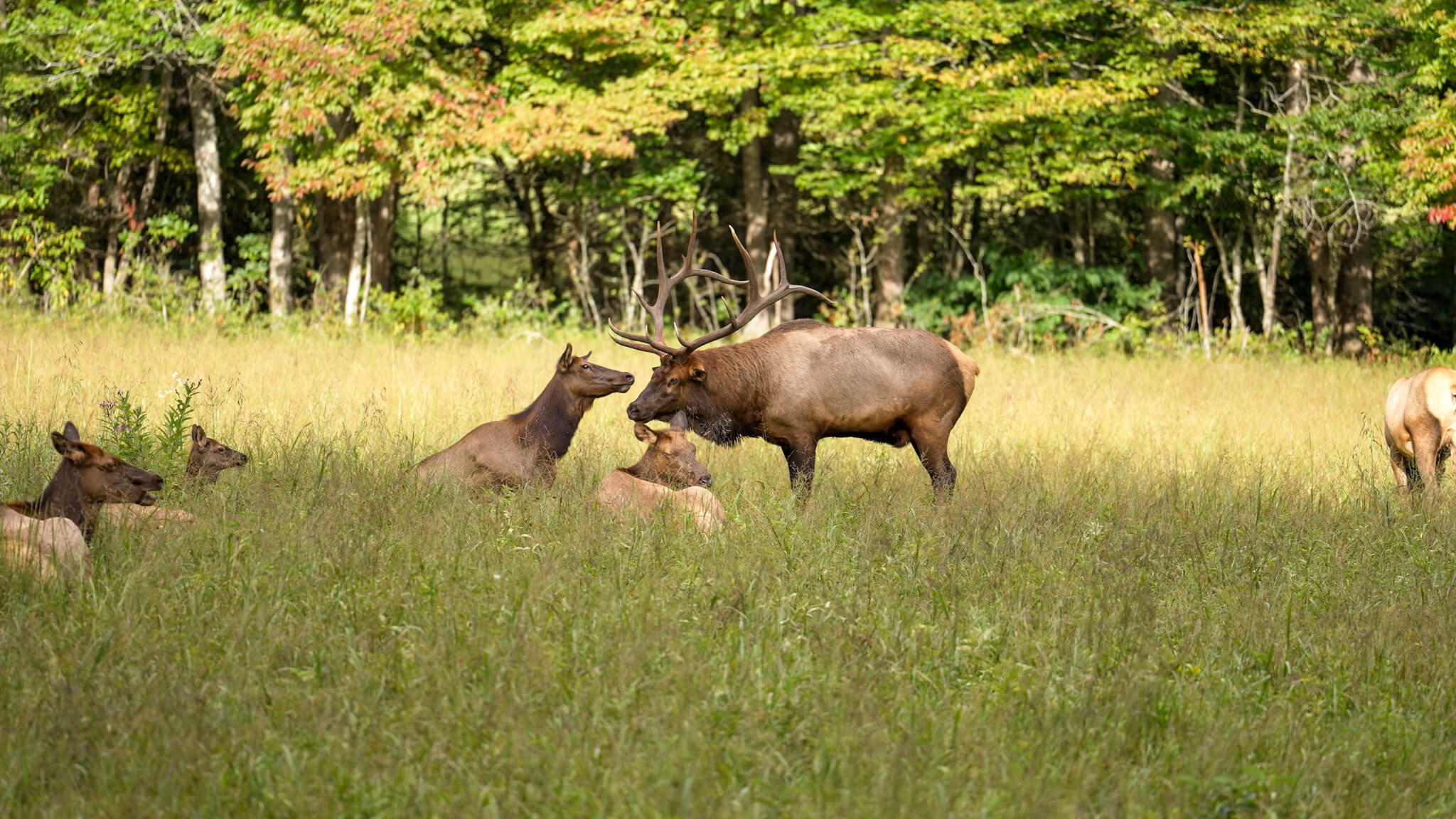
When you drive through Cataloochee or Oconaluftee in Great Smoky Mountains National Park, you’ll probably see elk – perhaps dozens of elk grazing in a field.
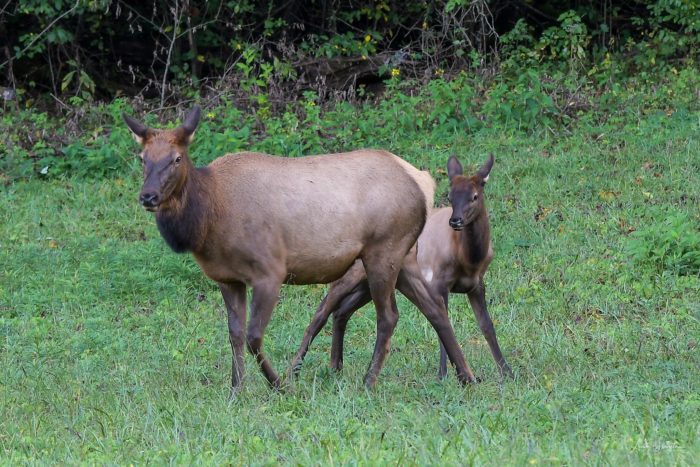
Male elk (bulls) can weigh up to 900 pounds, and female elk (cows) can weigh up to 600 pounds. Adult elk can stand four to five feet tall at the shoulder and have a body length seven to ten feet from nose to tail. The males grow a set of antlers each year that can reach five feet in length and span almost five feet in width.

Elk, one of the most iconic wildlife in the park, were absent from the area for more than 150 years, hunted to extinction by settlers.
But in 2001, elk returned to Great Smoky Mountains National Park thanks to a coordinated effort by the National Park Service, Rocky Mountain Elk Foundation, local communities, and a number of agencies and organizations, including Friends of the Smokies.
This year, the reintroduction of elk reaches its 25th anniversary.
“It’s a great milestone to hit,” said Joe Yarkovich, the park wildlife biologist who has coordinated the elk monitoring program since 2006.
“It all started as an experiment to see if the elk could survive and sustain themselves. Elk are now part of the Smokies landscape,” he said.

Elk reintroduced to park in 2001
The elk reintroduction project brought 25 elk from Land Between the Lakes National Recreation Area in Kentucky into the park in 2001. In 2002, 27 elk from Elk Island National Park, Alberta, Canada, were added to the park’s herd.
An upcoming blog post will share the story of the early years of the reintroduction project.
The initial 52 elk herd has grown to approximately 250-260 elk. Most of the elk live in Cataloochee and Oconaluftee, in the North Carolina section of the park.
“All the blood, sweat, tears were worth it, and the research was right,” Yarkovich said, referring to the population modeling done 25 years ago.
Monitoring the elk population
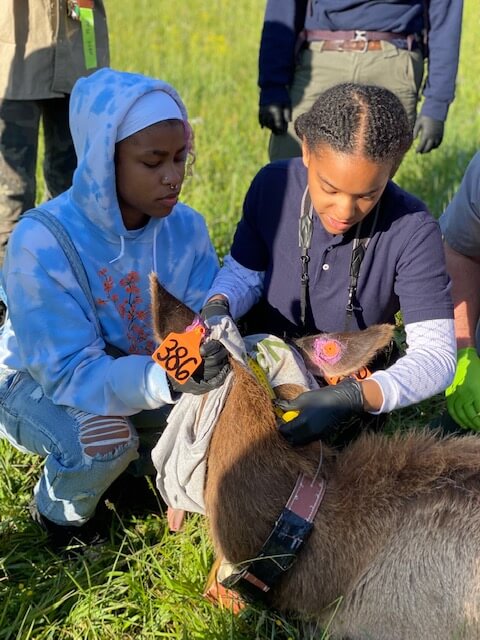
Initially, the park staff radio-collared and ear-tagged every elk so data from each animal could be collected and included in the research data.
“Once the herd was established, monitoring every elk wasn’t necessary,” Yarkovich said. “A subset of 40 to 50 now are wearing radio collars. That smaller sample gives the data we need.”
The radio collars transmit a VHF signal that can be tracked by a handheld antenna and provide data on where the elk are located. That lets the park staff find new calves and their mothers and also locate an elk that has died to determine the cause of death.
Park biologists regularly conduct health checks of the elk in the data group. Darting and handling elk allows staff to fit them with radio collars for tracking, implant a PIT tag (Passive Integrated Transponder microchip) and ear tags for identification, draw blood for disease testing, collect DNA samples, and assess the general health of an animal.
NPS staff also work cooperatively with the North Carolina Wildlife Resources Commission and the Eastern Band of Cherokee Indians to perform minimum elk counts and collect elk scat for DNA analysis every winter as part of larger research to track elk populations throughout the entire western North Carolina region.
All of that information becomes part of the data set that Yarkovich maintains and uses to assess the park’s elk population model.
The staff also conduct research to determine the impact the elk have on the habitat and other species in the park.


Elk adapt to new environment
“It’s been interesting for me as a biologist to see the elk adapt to the area,” Yarkovich said. “The first few years that elk were in the park the calf survival level was really low because the elk had no experience with black bears. They didn’t know how to hide their calves and how to protect them.”
Yarkovich described Cow Number 15, one of the elk from the Land Between the Lakes herd, as an example of how the elk adapted to their new environment.
The first year in the park, Cow Number 15 had her calf in a field, and the calf was killed by a black bear. The second year, Cow Number 15 had her calf on the edge of the woods. Again, the calf was killed by a black bear. The third year, Cow Number 15 traveled to Balsam Mountain to have her calf and then brought the calf back to the cove when it was older. That calf survived.
The park staff found that over the years, Cow Number 15 and all her female calves return to Balsam Mountain to give birth – and the calves survived.
Seeing elk creates excitement
Part of Yarkovich’s enjoyment in working with elk comes from observing the excitement for those who are seeing elk for the first time — park interns and seasonal employees and park visitors.
“I’ve been looking at elk every day for 20-plus years. People in the park every day are excited about the elk. They are thrilled because the elk are right there. People get out of their cars and immediately they’re smiling. It’s an awesome viewing opportunity, and they’re so excited,” Yarkovich said.
“I think elk also have had a positive impact on tourism and the local economy. This is one of the best places in the country to see elk in their natural environment,” he said.
Businesses incorporate elk into their business signage and products. Tour companies offer special elk viewing tours. Elk grazing in Cataloochee and Oconaluftee can cause traffic jams, with tourists stopping to watch and photograph the elk.

Friends of the Smokies’ support for elk
Friends of the Smokies plays an important role in the success of the elk reintroduction.
“Friends of the Smokes has been a supporter of the project from day one,” Yarkovich said. “Every year since the reintroduction, we’ve had them as a funding partner. The equipment we are using and the people we have in the field are the direct result of theFriends.”
Over the years, Friends has invested more than $300,000 to support the elk project.
“Friends has been proud to support this work for 25 years,” said Dana Soehn, Friends of the Smokies President and CEO. “Through license plate revenue, grants from Haywood County and donations, we’ve helped fund research, monitoring and the Elk Bugle Corp and Luftee Rovers –the volunteer groups who help educate thousands of visitors each year.
“When you see elk in the Smokies today, you’re seeing the result of decades of care, commitment and generosity,” Soehn said. “This is why supporting our national parks matters, because it creates moments and memories that last for generations.”
Safety tips for viewing elk
Park rules require visitors to be at least 25 yards from the elk.
Rules require visitors to move back from approaching elk to maintain that 25-yard minimum distance. If an elk advances and the visitor doesn’t move to maintain a 25-yard distance, the visitor would be at fault and could be fined. Visitors must stay 50 yards from bears.
“Keeping that distance really does protect the animal as much as the people,” Yarkovich said. “People want to get close for a photo. Then they want to feed it, and that really starts the behavior that is a downward spiral for the elk. The food is not healthy for the elk. And feeding the elk changes the elk’s behavior to approach people.”
Learn more about elk and safely viewing elk on the park’s elk webpage.
[An upcoming blog post will share the story of the process to reintroduce elk to the park.]

About Friends of the Smokies
Friends of the Smokies is the official nonprofit partner of Great Smoky Mountains National Park. Through private donations, fundraising events, and specialty license plates in North Carolina and Tennessee, Friends of the Smokies raises money to fund needed projects and programs in the national park that would otherwise go unfunded.
Learn more about how to get a Friends of the Smokies license plate at BearPlate.org. You can make a direct tax-deductible donation at our website. We are also grateful for those who make contributions at our donation boxes throughout the park. Every gift makes a significant difference for our beloved Smokies.
Sign up to receive our monthly e-newsletter and email updates at friendsofthesmokies.org/stay-in-touch/